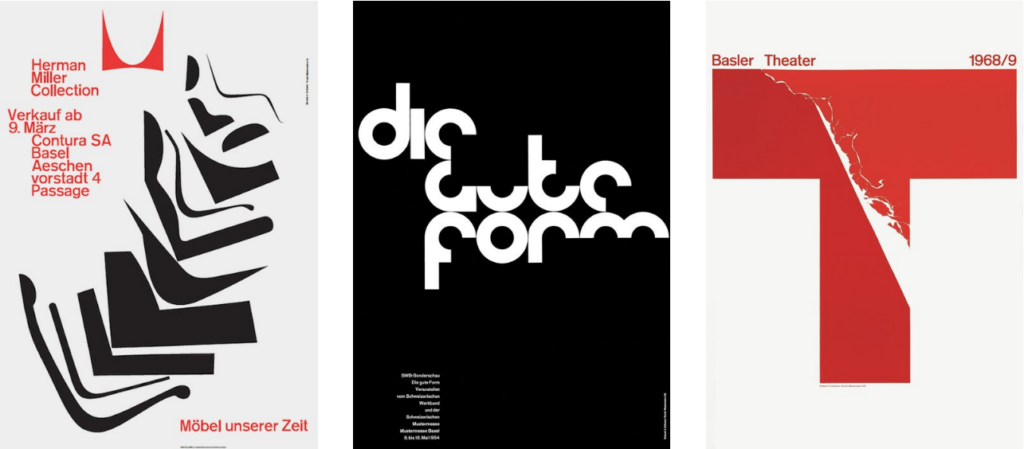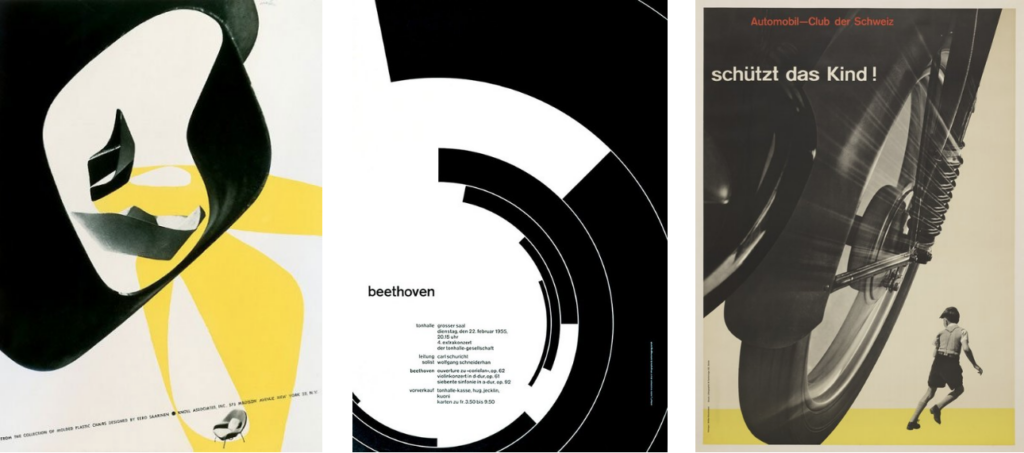

My approach to graphic design is influenced most by the Swiss Style designers Emil Ruder, Armin Hofmann, and Josef Müller-Brockmann. The Swiss Style, also known as the International Typographic Style, was developed in Switzerland in the 1950s. This style was defined by the use of sans-serif typefaces and page grid structures, producing asymmetrical layouts. By the 1960s, the grid had become a standard practice and came to reflect the style and methods of Swiss graphic design. The Swiss style emphasized the combination of typography and photography as a means of visual communication. Swiss designers were best known for their posters, which were seen to be the most effective means of communication of that period. The Swiss style influenced a generation of graphic designers in Western Europe and the United States. I’m one of them.
Emil Ruder was a Swiss typographer and graphic designer who lead the faculty at the Schule für Gestaltung Basel (Basel School of Design). He is distinguishable in the field of typography for developing a holistic approach to designing and teaching that consisted of philosophy, theory and a systematic, practical methodology. He expressed lofty aspirations for graphic design, writing that part of its function was to promote “the good and the beautiful in word and image and to open the way to the arts”. He was one of the major contributors to Swiss Style design and taught that typography’s purpose was to communicate ideas through writing, as well as placing a heavy importance on sans-serif typefaces. No other designer since Jan Tschichold was as committed as Ruder to the discipline of letterpress typography or wrote about it with such conviction.